Seriously, how many stories do you have about friends, life, or learning that involve a sleepover? Weren't sleepovers the best when you were a kid? Why? - because they involved popcorn, staying up too late, and ghost stories? Maybe, but I've got a different theory. The high-intensity, high-impact, no-rest time frame made memories extremely impacting. Those times were effective memory creators.
My past weekend wasn't exactly productive as a graduate student: I spent all day Friday, Saturday, and Sunday at a Draft-Legal Triathlon Camp for the Northeastern Collegiate Triathlon Conference (hence the swimming picture above). I didn't get any labwork done, but I learned an incredible amount as a triathlete. The Camp was 3 straight days, during which I was going the whole time, contributed all my mental energy to learning new skills, and teamed up with amazing triathletes from around the region.
After leaving the camp, I realized that the 3 days were extremely effective at teaching me triathlon skills! Committing a solid and confined period of time to these skills helped me to put them in practice much faster than if I had incorporated the learning into my regular routine.
How does this apply to grad school?
I wondered why we don't do similar things as graduate students. Going to conferences is similar, but I don't learn nearly as much at a conference. I wondered - what made this camp so effective?
Practice Practice Practice - At the camp, we would first learned about a skill, training technique, or tactic, and then we practiced it a ton! The opportunity to practice things immediately helped you understand what you were learning and gain a personal connection to the instructional point. It was interactive learning!
Feedback - The whole camp was run by very qualified coaches. We received continuous and immediate feedback from an outside observer who knew more about the skills than we did. Each skill was learned more effectively because we could adapt to the feedback.
Immediate Improvement - When we combined feedback and practice together, we were able to improve immediately. This improvement was a positive feedback cycle which helped promote our confidence, investment, and knowledge.
Find Your Weaknesses - We were "forced" to do things that we wouldn't normally attempt or fit into our regular routine. By practicing and working on a lot of different points, we were able to determine our strengths and weaknesses. By compacting all of these skills into a small time-frame, we were able to compare our strengths and weaknesses to each other. When you don't compare your strengths and weaknesses, it becomes easier to think that you are better at a weakness than you really are. When a weakness is directly compared to a strength, you can determine how much work is needed to improve that weakness.
Develop a Goal - When individual practices are completed with a large amount of separation between them, the feedback cycle can be too discontinuous to give you a clear vision of direction or goals. When the feedback cycle is shortened considerably, goals are easy to define and conviction for the goals are solidly concrete. During the camp, we effectively determined goals for ourselves which would incredibly improve our future in the sport, and these goals were backed up with a high degree of confidence.
Bonding and Building - More importantly than what we did individually what we did with the other members of the camp. We learned how to work with them as a team, trust each other because of team help and input, developed friendships, and look forward to interacting with each other in the future. These are the types of the relationships that can develop over longer periods of time (months or years?), but are highly accelerated when spending so almost every waking hour with the same people.
Why are workshops missing in grad school?
Sometimes, working in a research lab can seem like the same day-in-day-out. Why aren't there short periods of very internse skills learning, mentoring, practicing, and results seeking, and goal setting in the research lab?
There's room to change it up! What's collection of skills to people need to learn that can be taught by other grad students and post docs? What huge research questions needs answering and hypothesizing? We should all be able to trust each other with research results, questions, processes, and any other part of the labwork. Why do I have to wait on getting research feedback for over a week? Why is it the same-ole-same-ole?
Grad School Workshop! While it's a large commitment of time, the effectiveness is incredible. What better way to learn, teach, complete a task, organize a goal, brainstorm, get to know your coworkers, trust in everyone's knowledge and skill, and value the impact of your work? There's room to step out of the mold and make a difference!
How to be an Effective Graduate Student
Monday, October 21, 2013
Thursday, October 10, 2013
How to waste your PI's time...aka my top 3 efficient meeting tips
![]() |
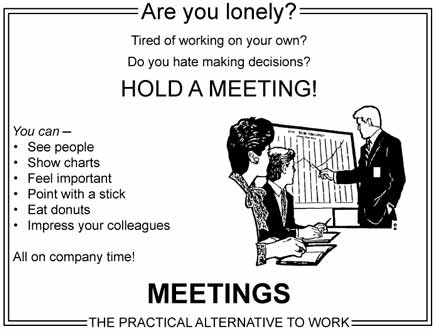
| This picture actually has little to do with this blog post, but it's one of my favorite meeting cartoons. |
Somewhat disgruntled, I thought: ***Where did I go wrong? What was the issue? Did I have the wrong idea of what I was supposed to be doing?***
At first, I was upset that all of my work had been for-not. Back to the drawing board for the umpteenth time. Chalk up the most recent outline version as "a good learning" lesson. But then it hit me - I was focusing too much on the present task at hand! This was a time to use my "sustainability mind" and not focus on the present.
I had just wasted both my and my adviser's time! Forget about the rejected outline - there was a bigger learning lesson at hand. Instead of allowing the meeting to constructively build on a strong-foundation of an outline, we had just wasted the meeting time because I delivered an unpolished and misdirected piece of work. Instead, we decided that this version wasn't going to lead to an effective publication, and I was left where I started.
Brief side note - My PI Adviser Availability Spectrum:
For some graduate students, their PI's are wildly available. These students might complain about their adviser's "hawkish," always-over-the-shoulder nature, but at least these students have plenty of opportunity for PI mentoring. On the other hand, some graduate students rarely see their PI. I'd say I am fortunate to find myself in the middle of this spectrum: enough hands-off-ness to allow for scientific and practical flexibility, but structured availability which steers my wayward research pursuits back on course. This particular paper-outline meeting was I prefer the more hands-on approach: I soon found out that my next opportunity for a paper outline meeting would be more than 3 weeks down the line. This was too far away for incremental feedback!
As a learning lesson, I asked myself how I could have made better use of my and my adviser's time. A
1) Pre-meeting briefing - In this situation, had my adviser seen my paper outline before the meeting, we could have reoriented the meeting to talk about the direction of the next revision. Instead, I didn't give him the necessary pre-meeting information, and therefore precious time meeting time was lost. In the future I will brief my PI with necessary information. When my PI comes into the meeting with reasonable preparation and pertinent ideas, the outcome can set the future direction, instead of mending previous mistakes.
2) Use of External Resources - I am spearheading this paper-writing effort, and therefore, I don't have a co-author who is immediately available for incremental feedback. Without internal support, the onus is placed on me to leverage other paper writing resources. I need to do a better job of taking advantage of online writing guides, example journal articles, reviews from my groupmates, and the on-campus writing center.
3) Meeting Material Potency - I came into the 15-minute meeting with a grossly lengthy agenda. While the raw content of the outline was at the heart of what I wanted to discuss with my PI, I would have been better off increasing the potency of my meeting agenda. I could have prepared some hand-drawings or powerpoint slides which explained my intent, instead of going through the paper outline line-by-line. When time is hard to come by, dredging through details is terribly ineffective. In the future, as I typically do, I will make sure to filter down my ideas into concise visual topics in order to increase the potency of meeting time.
TL;DR: Meetings are an opportunity to quickly reach concensus on a strong foundation and propel a project forward with a well-formulated future plan. Preparation for a meeting from both parties ensures that meeting time isn't completely wasted.
And there's more: While these ideas are appropriate for any interaction with an adviser, they are also pertinent to other meetings in life. Networking interview, group meeting, preliminary interview with a company, training on research equipment, journal club, even a doctor's appointment.
Again - today - I was reminded that preparation, the leg-work of sustainable efficiency, is vital. For important meetings, put in necessary preparation to be an efficient meeting participant.
Monday, October 7, 2013
Let's Rock this Shit!

Let me start by admitting: While I find politics fascinating, I am temporarily-in-my-young-adulthood too jaded to keep up with politics. What does this mean? I barely know a darn thing about the government shutdown.
But when I woke up on Monday morning to find that our Congress hadn't pass a resolution and had let the government had shut down, I felt a wave of emotions. First was malaise. Same ole same old, different day. Of course! Why would our Congress, maligned with a despicable track-record, be able to get it together? Ho-hum, nothing new here. Second was anger. I realized that this wasn't just another day. I'm a young adult, and ever I can work out my qualms with my coworkers and peers. How could the "adults" who I'd entrusted my nation too let politics get in the way. In the way of what? Of the freaking nation working!! Fine, be irresponsible on pity topics gun-control and the farm bill (obvious sarcasm), but don't let the political system screech to a halt! Third was mindfulness. As I'll discuss significantly more in this blog, I've been working on being emotionally cognizant of my feelings, what is externally influencing them, and what I can do to control my own emotions. And so, likely I've become accustom to, I mindfully chose to not let my elected politicians decide the fate of my emotions, morning, day, week...
Fourth was inspiration. I asked myself - if Congress can't run this country, it's up to me and the rest of my compatriots to keep the ship on track. That was it, time to rock it!
This is not to say that I am a slacker, but last week I was invigorated with a strong sense of purpose, motivation, intent, direction and profound resolve. Since starting at MIT, I haven't been able to find or grab hold of a clear purpose. MIT hasn't effectively handed down a leading beacon. My peers were engrossed in a myriad of worthwhile pursuits, though nothing has gained popular momentum. My professors, while wildly intelligent and supportive, didn't exactly provide leadership in any particular direction. Last week, I felt resolved vigor. Who cares "what" I was working on. More importantly, last week I knew "why". I, me, Sam Nicaise, had to pick up the slack. I was inspired.
The National Science Foundation currently fuels my graduate schooling. I'm a NSF Graduate Research Fellow, an NSF grant is paying for my research materials, and my projects revolve around two NSF research grants that I helped to write. That's THE National Science Foundation! I'm not simply a player in this game we call the USA. Due to my attachment to the NSF, I'm a huge USA-cog. I'm milled from my nation's belief that technology, scientific understanding, and the pursuit of education are fundamentally important to our future. While the nation's political future was flipped upside down last week... my cog? let's spin.
Ready to rock it? - I say that line way too often. But when I ask that question - a teammate before a race, a coworker before a meeting, or a roommate before cooking a delicious meal - I really want an answer. I want to know that they're all-in, fully committed, and have their sights set high. Now, this week, I'm "ready to rock it". Who knows how long how long the shutdown is going to smolder, but I'm not giving up. With all my might, now, more than ever, I'm inspired to shine. Not for myself, not for my adviser, not for my future, but for my nations future.
Subscribe to:
Comments (Atom)