 |
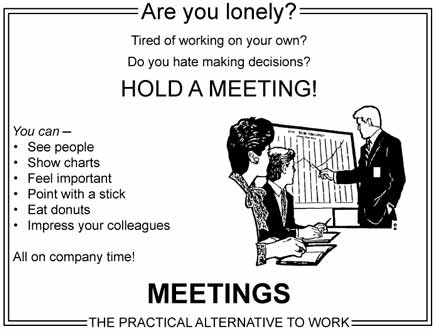
| This picture actually has little to do with this blog post, but it's one of my favorite meeting cartoons. |
Somewhat disgruntled, I thought: ***Where did I go wrong? What was the issue? Did I have the wrong idea of what I was supposed to be doing?***
At first, I was upset that all of my work had been for-not. Back to the drawing board for the umpteenth time. Chalk up the most recent outline version as "a good learning" lesson. But then it hit me - I was focusing too much on the present task at hand! This was a time to use my "sustainability mind" and not focus on the present.
I had just wasted both my and my adviser's time! Forget about the rejected outline - there was a bigger learning lesson at hand. Instead of allowing the meeting to constructively build on a strong-foundation of an outline, we had just wasted the meeting time because I delivered an unpolished and misdirected piece of work. Instead, we decided that this version wasn't going to lead to an effective publication, and I was left where I started.
Brief side note - My PI Adviser Availability Spectrum:
For some graduate students, their PI's are wildly available. These students might complain about their adviser's "hawkish," always-over-the-shoulder nature, but at least these students have plenty of opportunity for PI mentoring. On the other hand, some graduate students rarely see their PI. I'd say I am fortunate to find myself in the middle of this spectrum: enough hands-off-ness to allow for scientific and practical flexibility, but structured availability which steers my wayward research pursuits back on course. This particular paper-outline meeting was I prefer the more hands-on approach: I soon found out that my next opportunity for a paper outline meeting would be more than 3 weeks down the line. This was too far away for incremental feedback!
As a learning lesson, I asked myself how I could have made better use of my and my adviser's time. A
1) Pre-meeting briefing - In this situation, had my adviser seen my paper outline before the meeting, we could have reoriented the meeting to talk about the direction of the next revision. Instead, I didn't give him the necessary pre-meeting information, and therefore precious time meeting time was lost. In the future I will brief my PI with necessary information. When my PI comes into the meeting with reasonable preparation and pertinent ideas, the outcome can set the future direction, instead of mending previous mistakes.
2) Use of External Resources - I am spearheading this paper-writing effort, and therefore, I don't have a co-author who is immediately available for incremental feedback. Without internal support, the onus is placed on me to leverage other paper writing resources. I need to do a better job of taking advantage of online writing guides, example journal articles, reviews from my groupmates, and the on-campus writing center.
3) Meeting Material Potency - I came into the 15-minute meeting with a grossly lengthy agenda. While the raw content of the outline was at the heart of what I wanted to discuss with my PI, I would have been better off increasing the potency of my meeting agenda. I could have prepared some hand-drawings or powerpoint slides which explained my intent, instead of going through the paper outline line-by-line. When time is hard to come by, dredging through details is terribly ineffective. In the future, as I typically do, I will make sure to filter down my ideas into concise visual topics in order to increase the potency of meeting time.
TL;DR: Meetings are an opportunity to quickly reach concensus on a strong foundation and propel a project forward with a well-formulated future plan. Preparation for a meeting from both parties ensures that meeting time isn't completely wasted.
And there's more: While these ideas are appropriate for any interaction with an adviser, they are also pertinent to other meetings in life. Networking interview, group meeting, preliminary interview with a company, training on research equipment, journal club, even a doctor's appointment.
Again - today - I was reminded that preparation, the leg-work of sustainable efficiency, is vital. For important meetings, put in necessary preparation to be an efficient meeting participant.

No comments:
Post a Comment